
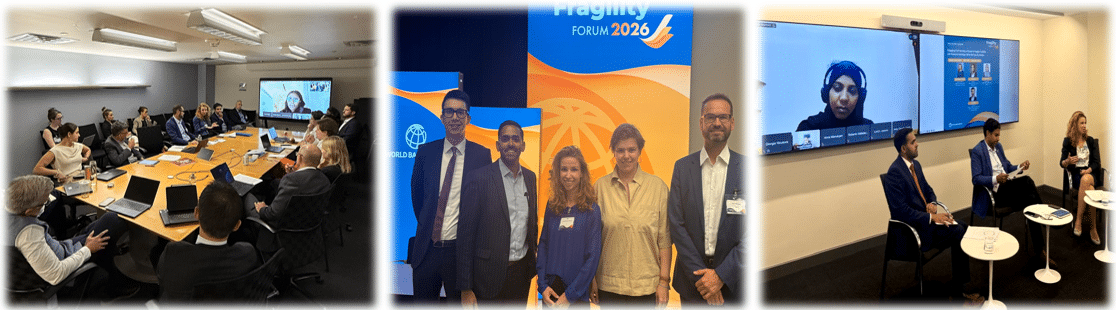
Between June 8 – 10, Nabni participated in the World Bank Group’s Fragility Forum 2026, joining policymakers, practitioners, development partners, civil society representatives and private sector actors working across fragile and conflict-affected contexts.
The Forum provided an important opportunity to reflect on how we can all work together more effectively to address the complex challenges facing communities affected by fragility, conflict and violence (FCV).
Several key messages emerged strongly throughout the discussions:
- The importance of locally led, peace-positive development, with priorities and solutions defined from the bottom up and grounded in local realities.
- The recognition that government leadership and civil society engagement are mutually reinforcing and that both are essential for achieving sustainable and inclusive outcomes.
- The value of partnership models that bring together development finance institutions, international organisations, governments and local actors to address complex challenges and achieve greater impact.
As part of the Forum, Nabni co-convened a Practitioner Panel discussion on delivering civil society partnership models at scale, alongside representatives from KfW Development Bank, the World Bank, and Nahda Makers Organisation, one of Nabni’s partners in Yemen.
Drawing on experiences from Iraq, Syria and Yemen – among others – the discussion explored what it takes to move beyond commitments to localisation and towards practical systems that enable more equitable partnerships. Panellists and participants reflected on the need to adapt financing mechanisms, risk management approaches and operational models to create meaningful opportunities for co-design, participation and local leadership.
The conversation also highlighted the role that “new types” of intermediary organisations – such as Nabni and the Norwegian Refugee Council – can play in bridging gaps between international funding structures and local actors, helping to strengthen locally led approaches while ensuring accountability and sustainability.
These discussions echoed the recommendations set out in the new Practical Guidelines for Supporting Locally Led Development recently published by the Organisation for Economic Co-operation and Development (OECD), particularly on the need to adapt funding, enable equitable partnerships, implement a co-design approach and adequate risk management approaches to enable greater local leadership and ownership.
Nabni is grateful to the World Bank Group for convening this important Forum and to all fellow panellists and participants for a rich and constructive exchange. We look forward to continue engaging in the conversation alongside our partners in Iraq, Yemen, Syria as well as our institutional partners and friends.
Post author: Giorgia Nicatore – Programme Lead, Nabni B4P Facility
June 2026